Download oobit app to pay with crypto everywhere.

Scan the QR code to download the app





_2026-07-27_12-57-05.avif)
The problem with gold was never buying it. The problem was selling it: find a buyer, agree a price, wait for settlement. Tokenisation solved storage and left that step exactly where it was. XAUt still had to be moved to an exchange, sold into a stablecoin, then into fiat, then withdrawn.
Now you can send XAUt to any bank account. A token whose every unit represents a troy ounce of physical gold in a Swiss vault goes from a self-custody wallet straight to a bank account, and the recipient sees local currency within seconds.
The transfer starts in the user's own wallet through DePay technology: the asset stays under their control right up to the moment of authorisation. From there the routing layer takes over, DTR infrastructure, which connects blockchain wallets to local banking systems.
The word doing the work is "local". The transfer does not travel a chain of correspondent banks over SWIFT, where every link adds time and a fee of its own. It lands in the domestic instant payment system of wherever the recipient is: SEPA and Instant SEPA in Europe, Faster Payments in the UK, ACH in the US, PIX in Brazil, SPEI in Mexico, INSTAPAY in the Philippines. For comparison, a conventional international transfer takes up to a week and costs 7-10% of the amount.
Before confirming, the user sees both numbers at once: how much crypto leaves the wallet and exactly how much fiat arrives in the account. There is no hidden rate sitting between them.
The swap has not disappeared. Someone is still selling gold for reais. What changed is whose job is: the conversion moved out of the user's task list and into the routing layer.
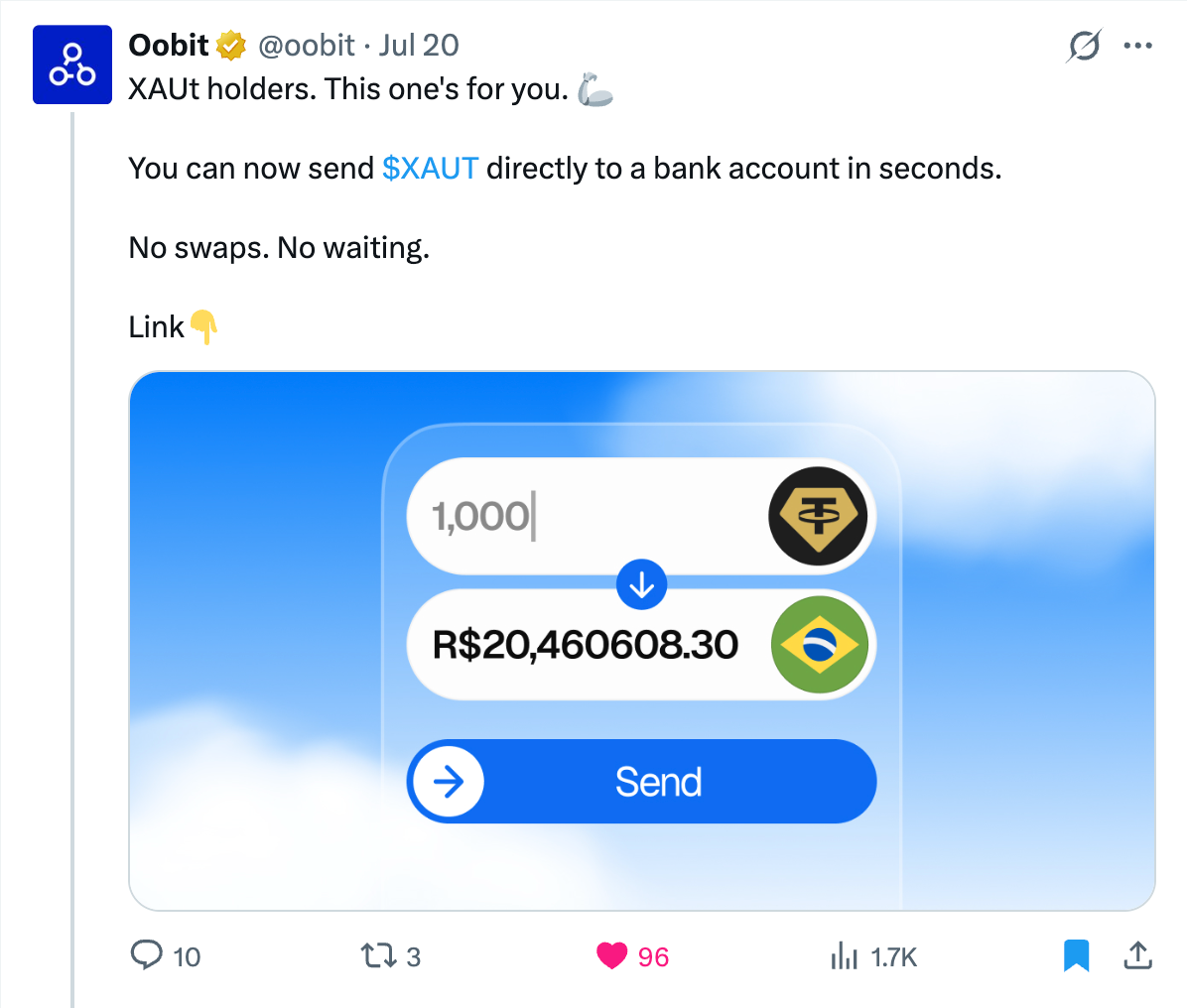
The same channel works identically for bitcoin, stablecoins, network tokens and tokenised gold, because it is indifferent to what the asset represents. Liquidity stopped being a property of the token and became a property of the pipe it is connected to.
For Oobit this is a third way of bringing crypto into the real world rather than a standalone product. The first is paying in store over with a crypto credit card at Visa accepted at more than 150 million merchants. The second is sending it to another person. The third is settling into a bank account. All three begin in the same self-custody wallet, with no balance to preload anywhere else.
For centuries gold was the least spendable form of savings anyone owned. Now it is a line in an app and a few seconds to settlement.








%202.svg)