Download oobit app to pay with crypto everywhere.

Scan the QR code to download the app






Over eight months, the number of active crypto card users whose settlement is visible on-chain rose from 282,000 in December 2025 to 410,000 in July 2026. That is 45% growth, roughly 4-5% a month, without a single down month.
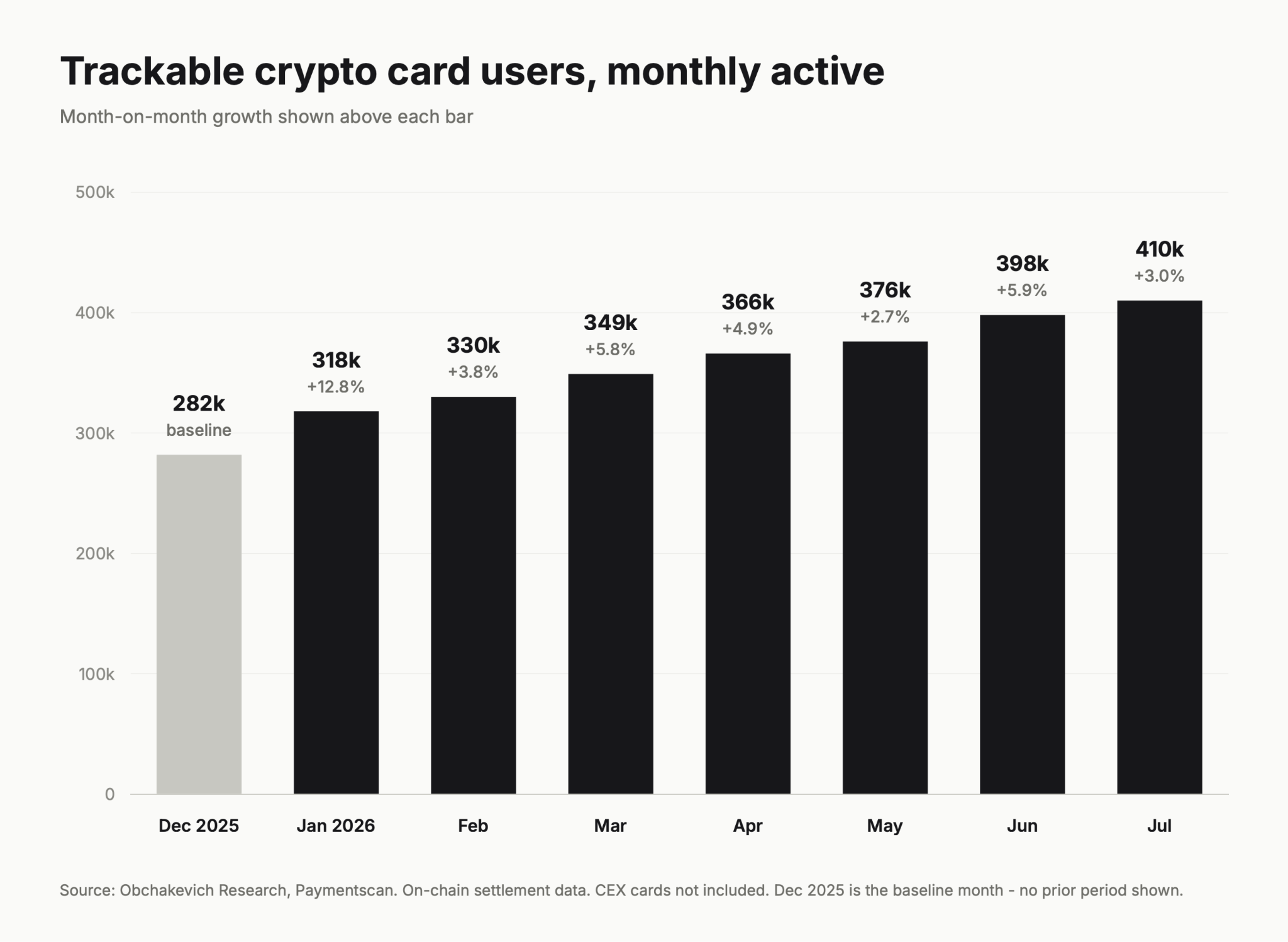
The interesting part is not the number but what is missing next to it. There is no rally. There is no price cycle to hang the growth on, which is the habit in this industry. In our Crypto at the Checkout research, transaction counts grew 2.7x while correlation with the bitcoin price sat close to zero. People did not start paying by card because their portfolio went up.
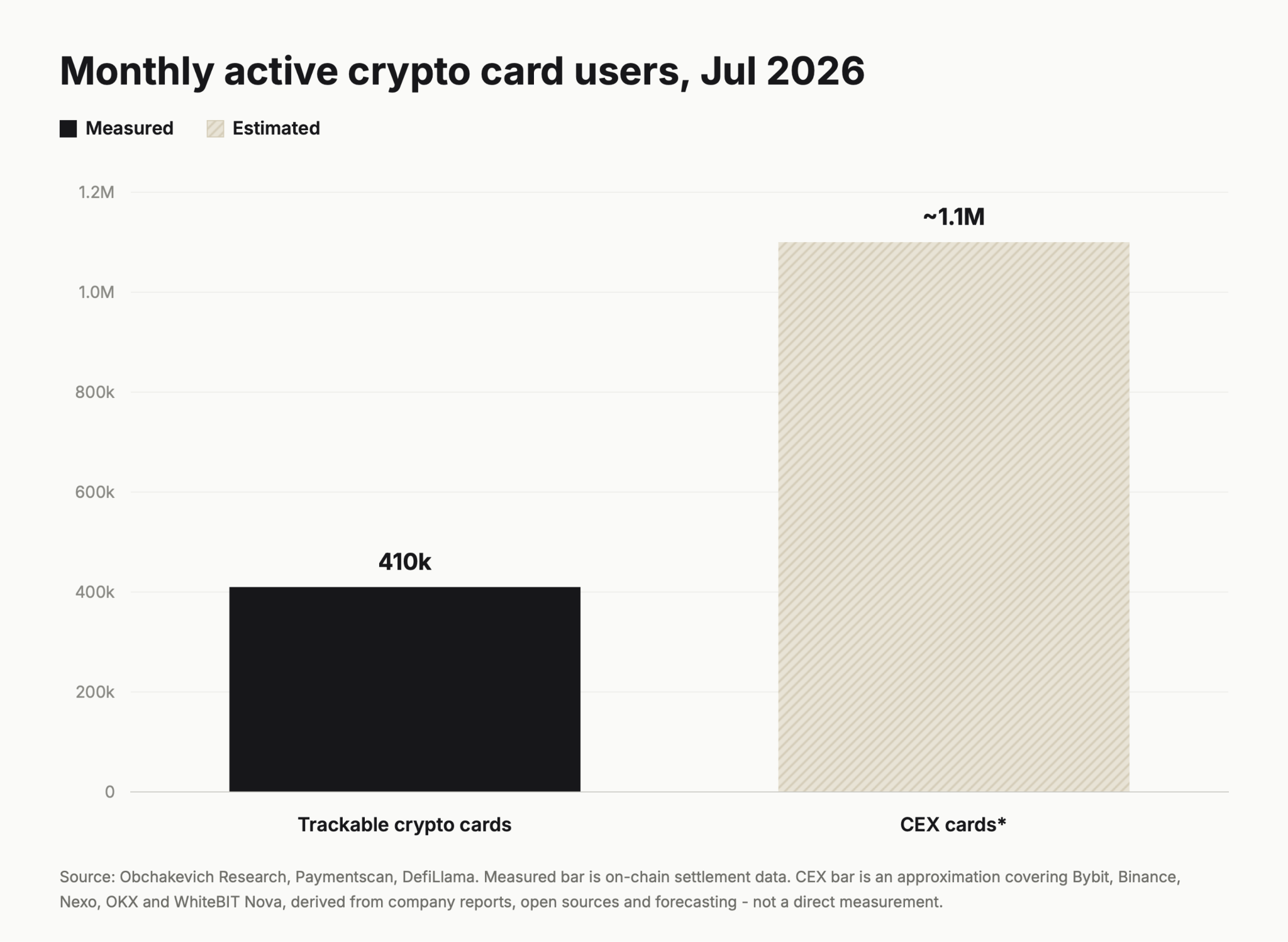
And this is only the visible portion. Cards issued by centralised exchanges - Bybit, Binance, Nexo, OKX, WhiteBIT Nova - run on internal balances and leave no blockchain trace. Our estimate, built from company reports and open sources, puts roughly 1.1 million more active users there. Together that is around 1.5 million people paying with crypto in ordinary shops on a regular basis.
First, the balance stopped being volatile. A few years ago, paying with crypto meant spending an asset that might be worth 15% more tomorrow: not a payment, a decision. Today most people hold stablecoins, and spending a dollar from a wallet is no different from spending a dollar from a bank account.
Then regulation. MiCA in Europe and the GENIUS Act in the US gave issuers workable rules, and programmes from the grey zone gained a legal path to scale. It shows in the data: growth is even, without the sudden drops that used to follow each programme shutdown.
And distribution. Exchanges built cards into apps people already used, with no separate onboarding. That is why exchange cards outnumber every on-chain trackable card combined by roughly three to one. The product did not win on features. It won by sitting one tap away from the money.
To be honest about it: crypto cards did not make cryptocurrency acceptable to merchants. They sidestepped the question by becoming an ordinary card on existing rails. In our data, around 79% of merchant locations accept contactless payment, 33% accept mobile wallets, and 0.19% accept crypto directly.
The cost of that solution is an extra step. The classic model asks you to top up a card balance first and spend it second. The money sits in an intermediate state: no longer in the wallet, not yet at the shop. Median top-up in our data is $90-135, a few days of everyday spending, after which you come back and reload.
At Oobit we built the product from exactly this point. Tap & Pay runs on Visa rails, the same rails as everyone else, because that is the only way to be accepted at 79% of locations rather than 0.19%. The difference is not the network. It is that there is no intermediate balance between wallet and terminal: conversion happens at the moment of payment, inside the routing layer.
The same principle runs through send by phone number, payouts to a bank account, Pix in Brazil, contactless cash withdrawal and Oobit Business. The user keeps a balance wherever it suits them, and the infrastructure takes on turning it into whatever the moment requires.
One and a half million active users are no longer early adopters, it is the beginning of a habit. The question for the next eighteen months is not whether people will have something to pay with, but how many steps are left between a balance and a payment.








%202.svg)