Download oobit app to pay with crypto everywhere.

Scan the QR code to download the app







Oobit has released its platform-wide growth results for H1 2026. Total transaction volume grew 267% for the six-month period of February through July 2026, nearly quadrupling over the period.
Growth was recorded across every major transaction category on the platform; card payment spend grew 209%, deposits rose 206%, while swap volume climbed 315%.
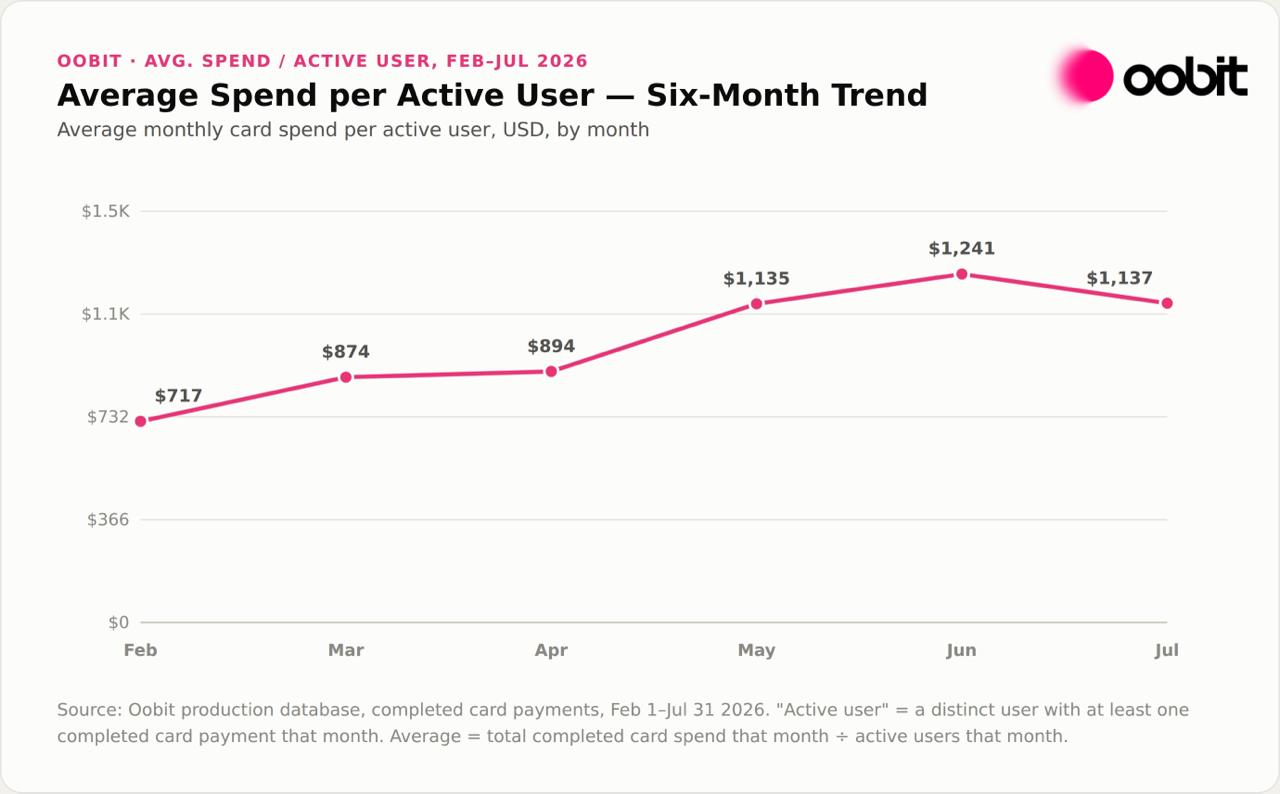
The growth was underpinned by real usage, with the number of active, paying users increasing by 95%, while the average monthly spend per active card user rose 58%, from $717 in February to $1,134 in July.
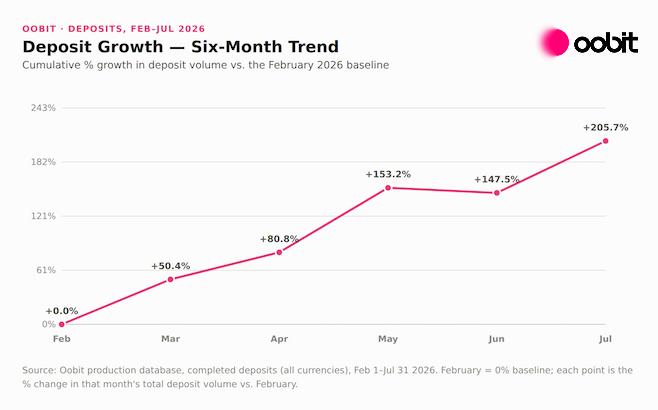
This means Oobit’s growth during the period came from both an expanding user base and higher spending among existing active users.
“Six months ago Oobit was a card for crypto-native early adopters. Today it's a daily spending habit for thousands of people across five continents. What stands out to us isn't just the volume, it's that spend per active user is up 58% too, which tells us people aren't just signing up, they're using Oobit more of the time they're already spending money. That's the harder growth to fake, and it's the one we're most proud of.” – Amram Adar, Oobit’s CEO.
Oobit’s platform growth came alongside a broader expansion of its products, payment rails and geographic reach between February and July 2026, extending how consumers and businesses can move, manage and spend digital assets.
In February, Oobit introduced global wallet-to-bank transfers, enabling users to move crypto from self-custody wallets directly into bank accounts through local payment rails. In March, Oobit expanded further into business payments with the launch of Oobit Business, its stablecoin-powered corporate finance stack, while also bringing its real-world crypto payments offering to Argentina and Chile.
Product expansion continued through the second quarter. In April, Oobit launched Agent Cards, introducing programmable spending capabilities for AI agents. This was followed by expansion into Colombia in May and integration with Brazil’s Pix network in June, extending access to crypto payments across key Latin American markets.
July brought another wave of expansion. Oobit launched in Guatemala and Paraguay, extended its crypto off-ramp to support USD withdrawals via SWIFT, introduced global ATM cash withdrawals, and launched a bank-transfer on-ramp, broadening the ways users can move between crypto, bank accounts and cash.
Oobit also continued expanding its wallet and embedded payment infrastructure during the period, including Plug and Pay integrations designed to bring wallet-held digital assets into everyday spending.
Together, these milestones expanded Oobit’s footprint across consumer payments, corporate spending, cross-border transfers, local payment rails and fiat access during the same period in which total platform transaction volume grew 267%.
Oobit’s corporate card product recorded the fastest growth of any product line during the period.
Completed corporate card transactions increased 1,194% between March and July 2026. March is used as the baseline because the corporate card product launched during that month.
The increase in this particular category reflects the growing use of Oobit beyond everyday consumer payments into business/corporate spending.
Monthly transaction count across the wide platform also increased 139% between February and July.
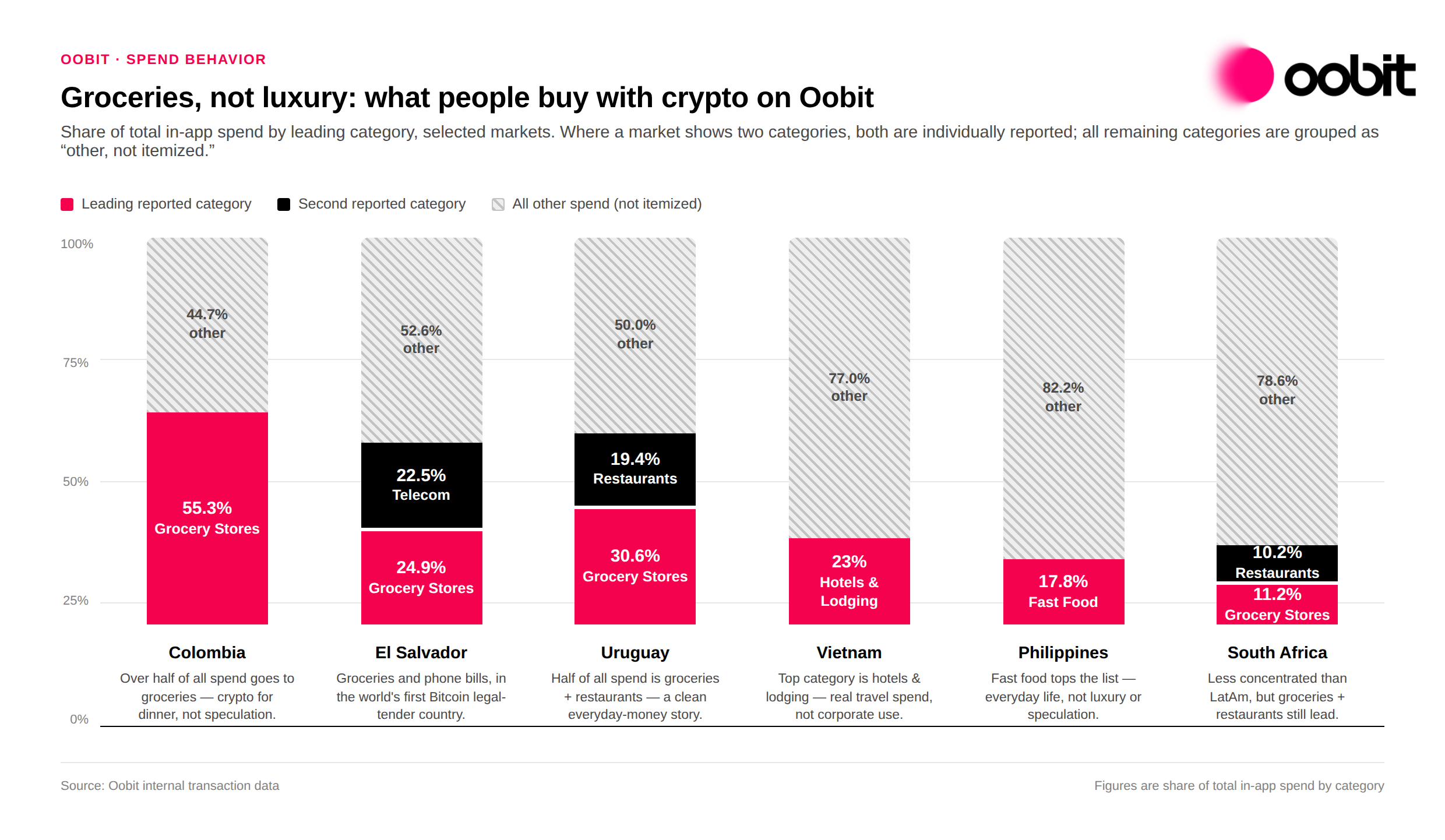
The transaction data also shows that digital assets are increasingly being used for everyday purchases.
Grocery stores and supermarkets accounted for 11.6% of total card spend during the period, making them Oobit’s largest merchant category. Restaurants represented 6.7% of spending, followed by travel agencies at 5.4%, hotels and lodging at 3.5%, and miscellaneous food stores at 3.4%.
Spending per active card user also increased significantly over the period. Average monthly spend rose 58%, from $717 in February to $1,134 in July, after peaking at $1,241 in June. On an implied daily basis, average spend per active card user increased from $25.59 in February to $36.59 in July, representing a 43% increase.
Oobit enables users to spend directly from multiple digital assets through a single card experience rather than requiring them to rely on one asset or pre-loaded balance. USDT, OOB, Bitcoin and Ethereum were the four most-used assets on the platform during the period.
Swap volume increased 309%, making it the fastest-growing major transaction type. The increase points to users increasingly converting assets as part of the spending process and using their crypto holdings directly for real-world payments.
Oobit's own token, OOB, saw usage volume grow 400% – statistically in line with USDT's 181% growth – suggesting users are routing everyday spend through Oobit's native asset at the same rate as the market's dominant stablecoin.
The growth was spread across several global markets in which Oobit is already present.
The United States, Colombia, the United Arab Emirates, Brazil and Italy were the five largest markets by card spending during the six-month period, highlighting the geographic spread of crypto payment usage across the platform.
Oobit’s results come as crypto cards continue to emerge as a growing channel for real-world digital asset and stablecoin adoption.
Industry data from Artemis Analytics, cited by CoinDesk in January 2026, showed crypto card spending growing at a 106% compound annual growth rate through the fourth quarter of 2025. By comparison, peer-to-peer stablecoin transfers grew just 5% over the same period, pointing to card-based spending as a significantly faster-growing use case for stablecoins.
The trend is also becoming increasingly visible across traditional payment rails. Visa-linked stablecoin cards accounted for approximately 19% of total crypto card volume in Q4 2025, according to the same data.
About the data
All figures are based on Oobit’s internal production data covering combined individual and corporate activity from February 1 through July 31, 2026. The six-month reporting period comprises the six full calendar months from February through July; August 2026 is excluded because the month was incomplete at the time of reporting.
Growth was not completely linear across the period. Total platform transaction volume was broadly flat in June, increasing 2.5% month over month, before rebounding 41% in July. The six-month figures therefore reflect the overall change between February and July rather than a consistent monthly growth rate.





%202.svg)